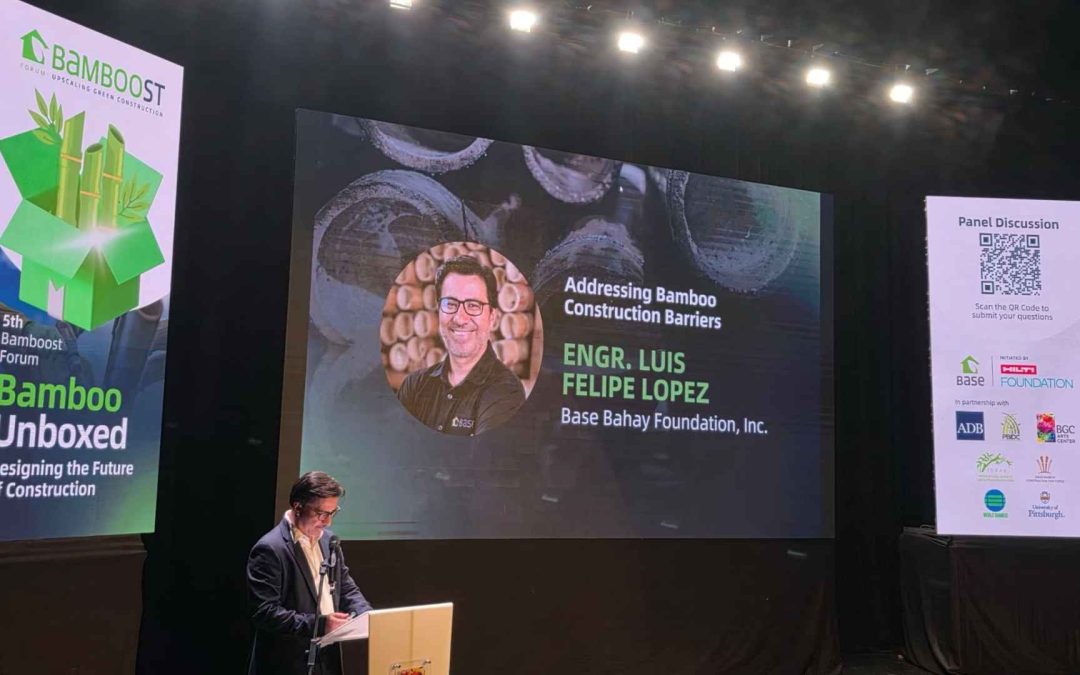
On September 30, 2026, more than 100 builders, engineers, researchers, and policymakers gathered at the Maybank Performing Arts Theater in Taguig City for a full day devoted to a single idea: that bamboo is ready for serious construction. The occasion was the 5th Annual Bamboost Forum, organized by the Base Bahay Foundation (BASE), the Philippine foundation whose innovation center develops the science, standards, and building systems behind much of its bamboo construction work. The Asian Development Bank (ADB), the Philippine Bamboo Industry Development Council (PBIDC), and the BGC Arts Center were partners. The theme was “Bamboo Unboxed: Designing the Future of Construction.”
The timing was nice. Just five days earlier, I had moderated a webinar where building codes, government policy, and the need to find a buyer came up again and again (read the recap here). The Bamboost Forum showed those same themes playing out at a national scale. And Mark Sebastian of Numat, one of our webinar panelists, was on the program.
In brief: What happened at Bamboost 2026
- BASE’s general manager says the goal is no longer to prove bamboo works, but to give the whole industry the confidence to build with it.
- A Philippine lawmaker laid out a package of bills that would touch everything from building codes to government purchasing.
- Presenters showed how treatment methods, digital modeling, and better connections are closing the gap between architects and artisans.
- Speakers from five other countries covered codes, structural reliability, treatment, and value chains.
The road to Taguig
The September forum was the culmination of a regional build-up. On August 7, BASE and the Mahintana Foundation hosted Mindanao Bamboost 2026, a regional forum for bamboo champions, government agencies, industry leaders, researchers, community groups, and development partners. The supporters included the South Cotabato Bamboo Development Council, the Mindanao Development Authority, Dole Philippines, and ChildFund. According to the World Bamboo Organization’s announcement, the logic was that a strong national bamboo industry can only be built on thriving regional ecosystems, so the conversation needed to reach local communities before it reached Taguig. The national forum itself was held during National Bamboo Month.
From proving bamboo to building confidence
Engr. Luis Felipe Lopez, who leads BASE, spoke about the center’s innovation work and its efforts to dismantle the global barriers to bamboo construction. At the heart of that work is the Cement-Bamboo Frame Technology (CBFT), a building system that pairs treated, load-bearing bamboo poles with mortar-cement plaster and metal connections to make affordable, disaster-resilient structures. Lopez also presented the CBFT Design suite, software that lets engineers and architects explore and design with the system.
His message was that proving bamboo works is only the beginning. The real objective, he said, is to “give an entire industry the confidence to build with it.” He also stressed that Philippine expertise is helping shape bamboo codes and building standards worldwide.
Congress takes up bamboo
One of the most striking moments came from Bukidnon Representative Jose Manuel Alba, who reported on a stack of legislation aimed at boosting the country’s bamboo industry. He told entrepreneurs that the rules are being cleared for them, and noted that the Senate version of a bill strengthening the Philippine Bamboo Industry Development Council passed its second reading the day before the forum. Here are the measures he cited:
| Measure | What it would do |
|---|---|
| House Bill 3377 and Senate counterpart | Strengthen the Philippine Bamboo Industry Development Council |
| House Bill 10812 | Embed bamboo structural codes in the National Building Code, targeting bamboo for 30 percent of wood-based structural needs within three years and 50 percent within five. Also brings structural composite engineering into university curricula and licensure exams for architects and civil engineers within five years |
| House Bill 14486 | Recognize bamboo as a high-value crop, opening access to agricultural lending, insurance, and tax holidays |
| House Bill 80360 (Bamboo Products Procurement Act) | Require national agencies and local governments to spend at least 25 percent of furniture and fixtures budgets on locally sourced, certified engineered bamboo |
| House Resolution 1420 | Reclassify bamboo as an industrial crop under the Department of Agriculture |
| House Resolutions 1418 and 1419 | Bring bamboo into airports, transport terminals, railways, and tourism zones |
Keep in mind that, as reported, most of these are pending proposals rather than enacted laws, so check their status before quoting any of them.
Design and treatment in practice
Arch. Jed de Guzman of the UAP Philippine Bamboo Projects Special Committee covered the frontiers of modern bamboo architecture. He walked through treatment methods including soaking, pressure systems, heat and torch smoking, and transpiration, which can be used alone or in combination. His practical advice was to favor bamboo species that builders and artisans can easily get, rather than chasing exotic ones. He also showed how CAD modeling, finite element modeling, and augmented reality can bridge the gap between architects and the artisans who actually build the structures, along with modern techniques such as stainless steel connectors and shell construction.
A global lineup
The rest of the program drew researchers and practitioners from around the world:
- Dr. Kent Harries (University of Pittsburgh, USA) on the challenges and opportunities in developing codes and standards for “nonconventional” materials
- Dr. Andry Widyowijatnoko (Institut Teknologi Bandung, Indonesia) on connection behavior and structural reliability
- Dr. Luisa Molari (University of Bologna, Italy) on research into natural construction materials
- Aoife O’Sullivan (Una Gama, Sri Lanka) on bamboo treatment and construction initiatives in Sri Lanka
- Diana Barrera-Salazar (Bauhaus Earth, Germany) on value chain and policy pathways for bamboo projects
- Carol Pobre (BGC Art Foundation, Philippines) on structural art and design through the Indayog Project
The closing session paired Mark Sebastian with Russell Smith of Rizome and Emil Bolongaita of the Asian Development Bank to discuss how digital traceability, transactions, and data could make the bamboo value chain more transparent, connected, and financeable. That’s an unglamorous topic, but it’s the kind that decides whether banks lend money to bamboo businesses.
A bigger conversation
BASE’s own wrap-up after the event struck a modest but telling note. Its main takeaway was that “we’re going to need a bigger conversation.” The organization thanked ADB, PBIDC, and the BGC Arts Center, and credited the speakers and the participants who came from different parts of the world. It also thanked broadcaster Ces Oreña-Drilon for moderating, Representative Alba for opening the discussion on bringing bamboo into mainstream construction, and the local and national government agencies that took part. BASE said it started Bamboost to create conversations around bamboo, and that five years on, it’s exciting to see how much that conversation has grown.
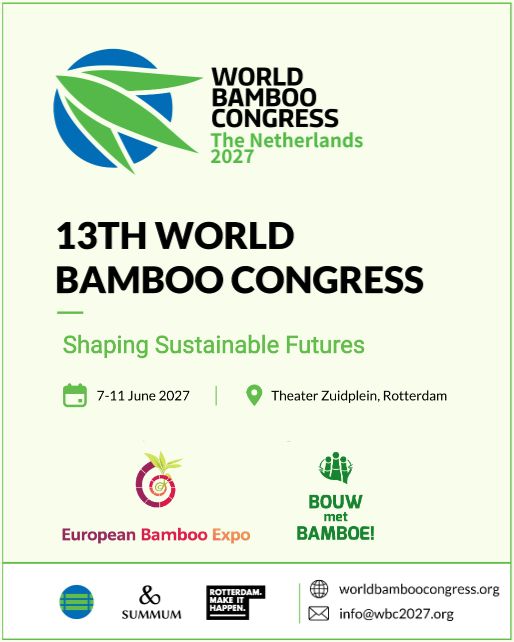
The next big gathering on the global calendar is the World Bamboo Congress 2027 in Rotterdam, the Netherlands, from June 7 to 11, 2027. According to the World Bamboo Organization, registration and a global call for papers are now open.
What it means for the bamboo industry
In our webinar, Jasper Niens told us that building codes are the biggest obstacle to engineered bamboo in architecture, and Juan Pablo Martinez described the slow work of drafting bamboo standards in Guatemala. Mark asked the question every producer needs to answer: who is going to buy it? The Philippines is attempting to address all three at once, with codes, policy, and purchasing power. A procurement mandate like the proposed 25 percent would be a ready-made answer to Mark’s question, at least for engineered bamboo products.
Whether those bills become law, and how quickly, is another matter. But the direction is clear, and other bamboo-producing countries will be watching.
Bamboo has been holding up roofs for centuries. Now it just needs the paperwork.
Fuel for thought
To learn more about bamboo in construction and in the Philippines, take a look around our website. You might find some of these articles especially interesting.
- Bamboo in the Philippines
- Can I build a house from bamboo?
- Fabulous prefab bamboo living homes
- The best architecture schools for bamboo visionaries
Source: Carla Mortel Baricaua, “5th Bamboost Forum: Upscaling green construction with bamboo,” Manila Bulletin, October 9, 2026.
Additional sources: Base Bahay Foundation’s post-event announcement; World Bamboo Organization, “Mindanao Takes Center Stage as Bamboost 2026 Expands the National Conversation on Sustainable Bamboo Development,” July 1, 2026.