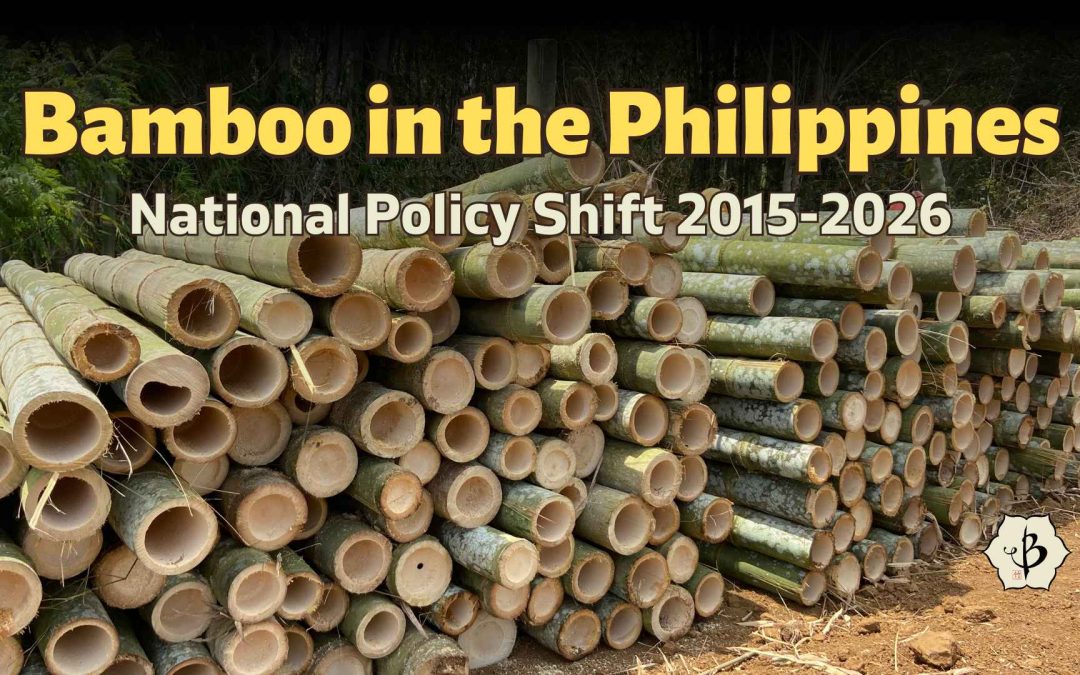
In 2015, the Philippine government published a remarkably candid document about its own bamboo industry. The Philippine Bamboo Industry Development Roadmap said, in plain language, that there was little reliable data on the industry, not enough raw material, no single agency in charge, and government policies that didn’t support it.
A decade later, those same problems are back in front of Congress. On October 8, 2026, the Senate approved the Kawayan Act on third and final reading, with 16 votes in favor and none against. That’s a real milestone, but it’s the latest step in a story that has taken more than ten years to unfold.
I’ve been working through the primary documents: the 2015 roadmap, the Department of Environment and Natural Resources (DENR) rules of 2021, a 2023 Senate bill, and two House bills filed in 2025. Here’s what changed, what didn’t, and what’s still missing.
In brief: A decade of Philippine bamboo policy
- 2015: The roadmap diagnoses the industry’s institutional and economic hurdles and sets goals through 2040.
- 2021: DENR issues its first rules specific to bamboo harvesting and transport, replacing a patchwork of permits with a single registration.
- 2023 to 2025: Senate and House bills propose a permanent council, dedicated funding, procurement targets, and investment incentives.
- October 2026: The Senate passes the Kawayan Act on third reading. Nothing has been signed into law yet.
2015: A candid diagnosis
The roadmap’s executive summary lists six findings. There’s a dearth of data. Raw material supply is insufficient across all sectors. No agency is responsible for overseeing the industry. Current policies aren’t supportive. Some investors are making big-ticket bets. And the government is starting to recognize bamboo’s social, economic, and environmental value.
The details are worth a closer look, because many of them reappear in later bills.
Bamboo was legally a minor forest product. The roadmap traced this to the 1975 Revised Forestry Code, which never mentioned bamboo by name. The result, it argued, was very little government support, and DENR had never issued a policy specific to bamboo, unlike rattan.
Moving bamboo meant paperwork. Bamboo from private land needed a Certificate of Verification from the local DENR office (₱20 per issuance), and bamboo from forest lands needed a Certificate of Origin. Bamboo was also on a regulated export list approved in December 2013, requiring permits from both DENR and the Department of Trade and Industry (DTI). The roadmap noted these were costs farmers could hardly afford.
The institution had no resources. Executive Order 879 of 2010 created the Philippine Bamboo Industry Development Council (PBIDC) with ₱20 million in initial funding, but no dedicated staff. The secretariat was a working group borrowed from member agencies, and the money had run out.
Engineered bamboo had stalled. At least ten enterprises had ventured into engineered bamboo, mostly for school desks, and the roadmap says most closed for lack of raw materials. It also noted that engineered bamboo hadn’t been included in the National Structural Code, which kept it out of mainstream construction. If that sounds familiar, it’s a pattern Mark Sebastian described again at our recent webinar.
The roadmap also flagged threats we still hear about today: cheap Chinese bamboo products in local markets, and the lack of a certification system as European buyers began demanding proof of sustainable sourcing.
Its targets were ambitious. About 69,000 hectares of new plantations over 30 years. Eight goals to be reached by 2040, including a stable institution, supportive policies, self-sufficiency in raw materials, and reliable markets. The estimated cost was about ₱26.3 billion over 20 years (2016 to 2035), and the roadmap noted that planned and ongoing private and bank investments, estimated at ₱34.1 billion, were already larger than that.
2021: The first bamboo-specific rules
The next major step came from DENR. Administrative Order 2021-26, signed on August 2, 2021, set out rules for establishing, harvesting, and transporting bamboo. It was the kind of DENR policy the roadmap said had never existed. And it echoed recommendations made in a 2015 policy brief from the Forest Management Bureau, cited in the roadmap: register plantations, exempt registered owners from transport permits, and build a database.
The main changes:
- One registration replaces several permits. Commercial plantations register with the local DENR office, and the Certificate of Bamboo Plantation Registration serves as the cutting and transport document.
- Less burden for small growers. Backyard farmers who harvest for personal use within their own municipality don’t need to register. Tenure holders and backyard farms are exempt from the application fee, and registrations for private and agricultural lands don’t expire.
- Financial relief. Registered plantations are exempt from forest charges, and plantation owners on public land are exempt from the government share for the first ten years or until they start harvesting, whichever comes first.
- Freer exports. Bamboo poles and resources from registered farms can be exported without restriction.
- Data. DENR is directed to build a bamboo information system covering plantations, processors, and markets.
It was a real improvement, but a limited one. There’s still a one-time registration fee of ₱3,000 for most applicants, a site assessment using GIS maps and geotagged photos, semi-annual harvest reports, yearly monitoring, and penalties for unregistered harvesting. And as a DENR order, it couldn’t touch the bigger items: the council’s funding, tax and credit incentives, procurement, or building codes. Plantations established under Department of Agriculture programs are outside its scope.

2023 to 2025: The legislative push
The bigger changes would need Congress.
Senate Bill 2513, the “Kawayan Act” (December 2023). Filed in the 19th Congress as a substitute for eight earlier bills, it proposed a five-year national roadmap, a reconstituted PBIDC with a secretariat headed by an executive director on a six-year term, and a long list of mandates. These included bamboo for at least 25 percent of DENR’s annual reforestation programs, 20 percent of DOST’s small business assistance funds for bamboo enterprises, and 25 percent of public school desks “as far as practicable.” Incentives included priority investment status, rent and forest charge exemptions, loan collateral recognition, crop insurance, and exemption from cutting and transport permits for registered plantations.
House Bill 2884 (August 2025). Filed by Rep. PM Vargas in the 20th Congress, it strengthens the PBIDC under DTI, creates a Bamboo Industry Research and Development Center as its secretariat, and requires provinces to draw up their own programs within two years. Its incentive list is the longest of the three: tax-free importation of plantation and processing equipment, income tax deductions for plantation expenses, no checkpoint inspections, and unrestricted culm exports, among others. The explanatory note says the measure was refiled after an earlier version passed the House on third reading and was sent to the Senate, which tells you how long this has taken.
House Bill 5835, the “Kawayan Para sa Bayan Act” (November 2025). Filed by Rep. Agatha Paula “Agay” Cruz, it institutionalizes a five-year national blueprint called KABAYANI, reconstitutes the PBIDC (repealing EO 879), and creates a Bamboo Research and Innovation Center. It also proposes the 25 percent DENR reforestation target and directs agencies to prioritize bamboo in public facilities. The explanatory note blames the same problems the 2015 roadmap identified: fragmented institutional mandates, weak research linkages, inconsistent incentives, and no unified national strategy. (I was pleased to see our own Bamboo in the Philippines article cited as a source.)
October 2026: The Senate acts
According to news reports, the Senate approved the Kawayan Act (reported as Senate Bill 2495) on third and final reading on October 8, 2026, with 16 affirmative votes. Sen. Juan Miguel Zubiri sponsored it. The bill establishes a five-year roadmap, reconstitutes the PBIDC, and earmarks 20 percent of DOST’s SME assistance funds for bamboo-based businesses. Zubiri warned that the industry has plateaued and is lagging behind Vietnam and Indonesia.
Both chambers still have to agree on a final text before it can go to the President, and I haven’t seen confirmation that this has happened.
What changed, and what didn’t
| Issue | 2015 roadmap | 2021 DENR order | Pending bills |
|---|---|---|---|
| Institution | PBIDC exists but has no dedicated staff or funds | No change | Reconstituted council with a dedicated secretariat and annual budget lines |
| Harvest and transport | Multiple certificates; bamboo on the regulated export list | Single registration serves as cutting and transport document; ₱3,000 fee | Registered plantations exempt from cutting and transport permits |
| Incentives | Roadmap calls for tax holidays, rent-free public land, insurance | Forest charge exemption; rent exemption on public land; free export | Investment priority status, crop insurance, collateral, credit access; tax measures in HB 2884 |
| Data | “Dearth of information” | DENR information system | National bamboo information system |
| Demand | DepEd desk mandate cited in the roadmap | Not addressed | Procurement and reforestation targets; DOST funding earmark |
| Building codes | Not in the National Structural Code | Not addressed | Not in these bills; separate proposal reported at Bamboost |
Does the story hold up?
Mostly, yes, with two caveats.
The arc is real: a candid diagnosis in 2015, a friendlier administrative rule in 2021, and a far more ambitious legislative package since. Each bill reaches for the problems the roadmap named. But the 2021 order was a modest step within one agency’s authority, and it came six years after the policy brief that recommended it. And all of the 2023 to 2025 measures are bills, not laws. A Senate vote is the closest any of them has come, and a decade has already passed since the roadmap’s diagnosis.
The second caveat is that policy can open doors without filling the plantations. The roadmap’s central constraint was raw material. Incentives, procurement targets, and institutions help, but they don’t produce culms. As Juan Pablo Martinez told our webinar audience about Ghana, 200,000 hectares on paper isn’t the same as straight poles at the factory gate.
Practical takeaways for growers and investors
- Register your plantation. Under the 2021 order, registration is what allows you to cut, transport, and export without separate permits.
- Watch the bills, not just the headlines. The incentive packages differ in the details, so what finally passes will matter more than what’s proposed.
- Ask where your demand will come from. Procurement targets could create guaranteed buyers, but only if they survive the final text.
- Keep an eye on codes. The roadmap named engineered bamboo’s absence from the structural code as a barrier in 2015. That barrier still stands.
Bamboo grows fast, but legislation grows slowly.
Fuel for thought
If you found this summary helpful and insightful, you’ll probably enjoy these other articles and videos as well.
- Bamboo in the Philippines
- Growing bamboo for carbon credits in 2026
- Bamboost Forum recap
- YouTube: Building a Bamboo Economy
Sources: Philippine Bamboo Industry Development Roadmap (2015); DENR Administrative Order No. 2021-26, “Rules and Regulations Governing the Establishment, Harvesting and Transport of Bamboo” (August 2, 2021); Senate Bill No. 2513, 19th Congress (December 12, 2023); House Bill No. 2884 (August 4, 2025); House Bill No. 5835 (November 11, 2025); “Senate OKs bill to boost bamboo industry,” Iloilo Metropolitan Times, October 9, 2026; “Senate approves bill institutionalizing Philippine bamboo industry program,” Daily Tribune, October 13, 2026.