
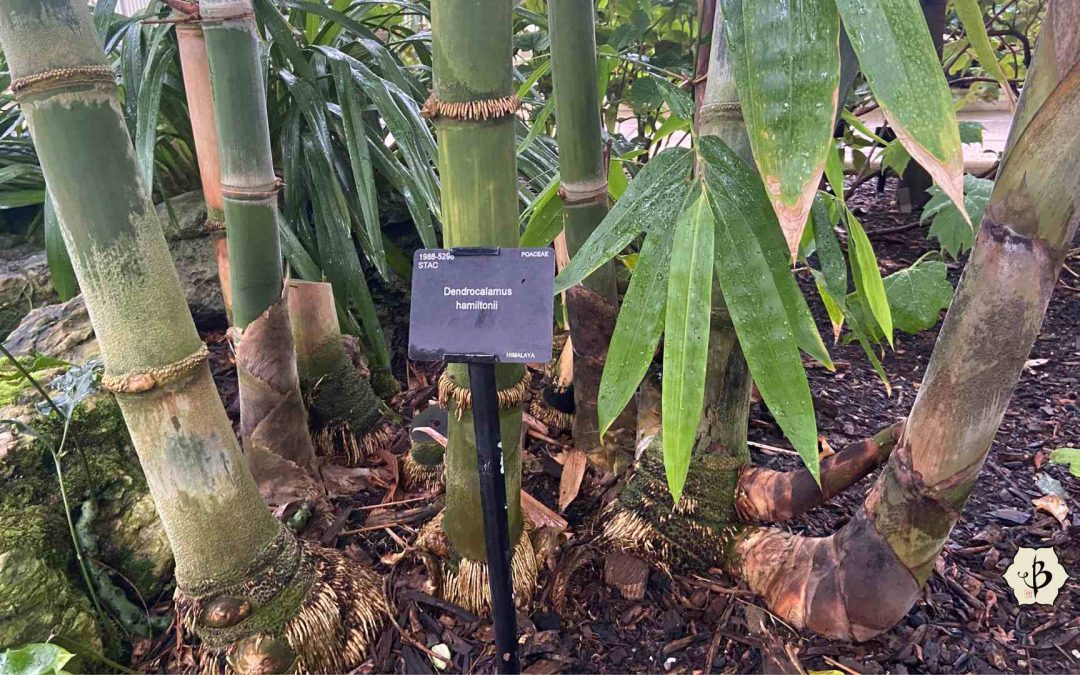
Dendrocalamus hamiltonii is a large clumping bamboo native to southern Asia, including India, Pakistan, Sri Lanka, southern China, and Southeast Asia. Culms are thick and strong, but not perfectly straight, so they may have industrial applications, but are not ideal for construction uses that require long, uniform poles.
This article is part of a series describing dozens of different bamboo species. To learn more, head over to our Complete Guide to Growing Bamboo and our comprehensive Directory of Bamboo Species. You can also explore other important commercial species in here:
- Bambusa balcooa: Beema Bamboo
- Bambusa oldhamii: Chinese Timber Bamboo
- Dendrocalamus strictus: Calcutta Bamboo
NOTE: This article was first published in September 2024, most recently updated in May 2026.
Quick Facts about Dendrocalamus hamiltonii
- Scientific name: Dendrocalamus hamiltonii
- Common names: Hamilton’s Bamboo, Hamilton Bamboo
- Type: Densely clumping bamboo
- Native range: South and Southeast Asia, especially the Himalayan foothills
- Climate: Tropical, subtropical, monsoonal
- Cold tolerance: Moderate frost tolerance for a giant tropical bamboo
- Drought tolerance: Moderate; more drought-resistant than many tropical species
- USDA zones: Approximately 9b–11
- Mature height: 60–70 feet (18–21 m)
- Culm diameter: 4–6 inches (10–15 cm)
- Culm appearance: Gray-green, thick-walled, often slightly zig-zagged
- Branching: Begins low on the culm, sometimes near the base
- Clump size: Medium-large; generally smaller than D. asper or D. giganteus
- Growth rate: Fast-growing under warm, wet conditions
- Soil preferences: Well-drained soils with moderate fertility
- Water needs: Moderate to high during establishment
- Primary uses: Biomass, pulp, charcoal, biochar, light construction, fencing, erosion control
- Construction quality: Strong culms, though not ideally straight for formal structural use
- Ornamental value: Moderate; less elegant than some giant timber bamboos
Characteristics of Dendrocalamus hamiltonii
Like other giant bamboo species in the Dendrocalamus genus, D. hamiltonii can reach heights of 60 to 70 feet with culms measuring 5 to 6 inches in diameter under ideal conditions. These conditions are typically found throughout the tropical and subtropical regions of southern Asia and parts of sub-Saharan Africa, where the species has been introduced.
D. hamiltonii is also somewhat drought-tolerant, requiring less water than other varieties of tropical bamboo. Relative to other tropical timber species, this makes it better adapted for seasonally dry climates, including parts of the African savanna and monsoonal regions of South Asia.
The culms of Hamilton’s bamboo are usually a dull grayish green. Branching starts low on the plant, all the way down to the base of the poles, similar to Dendrocalamus strictus, but unlike D. asper or D. giganteus. This makes the plant less attractive as an ornamental species. As with other members of the genus, branches form in clusters at the nodal joints with one main branch and several smaller ones.
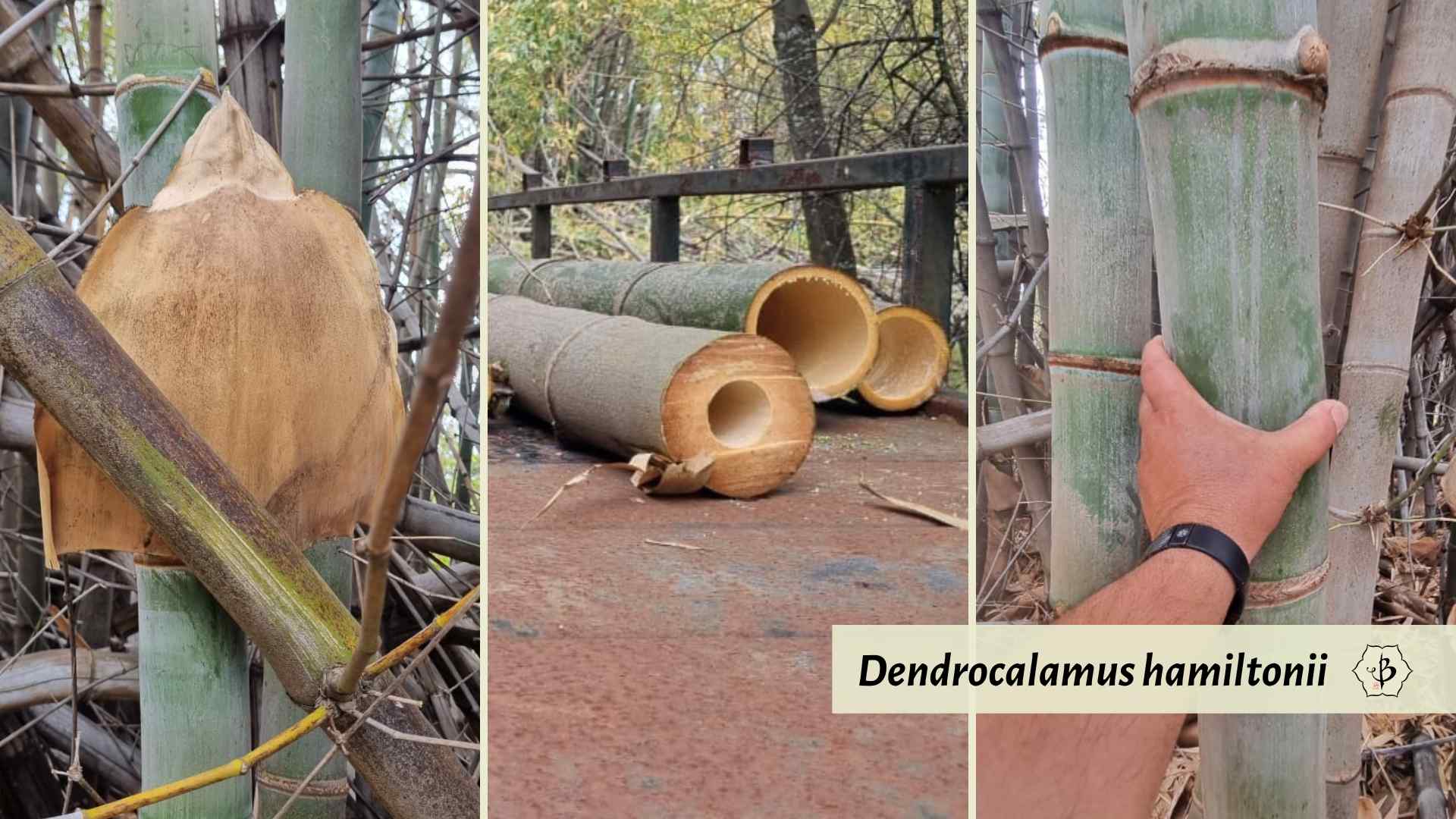
While the culms are similar in size to other giant bamboo species, the clumps will not reach the size commonly seen with other massive varieties. A dense, mature clump might contain 20 to 30 culms, compared to 50 to 100 in species like D. asper or D. giganteus.
Also, the culms are not very straight, but tend to zig-zag, which makes them less useful for formal building purposes. However, the culms are quite thick, so they are very strong and sturdy. Therefore, Hamilton’s can be a good building material for construction applications that do not require straight poles. The thick-walled culms also produce ample quantities of biomass, making this a good candidate for pulp, charcoal, and biochar.
Further reading
To learn more about bamboo in other parts of the world and its many uses, take a look at some of the other articles.
PHOTO CREDIT: Tidy clump of Dendrocalamus hamiltonii in the temperate greenhouse at Kew Gardens, London. Photo by Fred Hornaday.