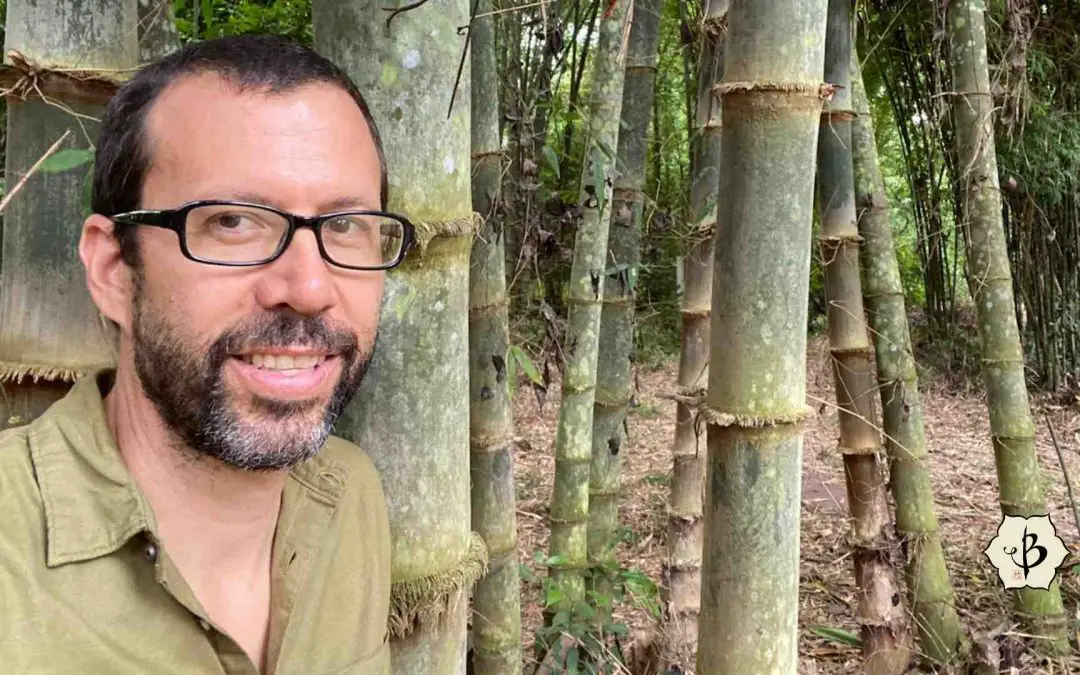
My love affair with bamboo started quite innocently. To be honest, I can’t tell you exactly when it all began. Perhaps it was a quiet stroll through the Japanese Garden at Golden Gate Park in San Francisco, or it could have been during a visit to the Huntington Library and Gardens in Southern California. It happened slowly, then suddenly, dramatically shifting from a curious fascination to an intense infatuation. At times, I would find myself daydreaming about Phyllostachys culms and doodling them in the margins of notebooks and steamy novels. Next thing I knew, I was sketching bamboo scenes with ink and brushes, and one day, I was painting a Hokusai-esque mural on the side of a building. Then months would pass without bamboo crossing my mind. For years, it went on like this, vacillating between hot and cold. But for the last 3 or 4 years, as we’ll see, it’s been exceptionally hot.
Beginning with Bambu Batu
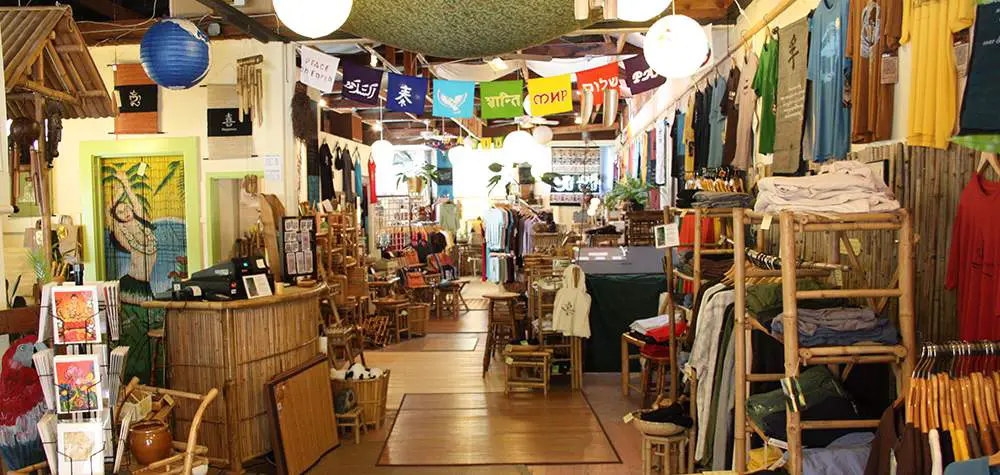
It was nearly two decades ago, in 2006, that my bamboo passion came into full bloom. That’s when I opened Bambu Batu, the first all-bamboo boutique in California – if not the whole country – dedicated to the celebration and promotion of this singular, extraordinary grass. We carried everything from bamboo chopsticks to bamboo rocking chairs to bamboo-silk lingerie. The message of non-toxic, sustainable resources reverberated across the land, and progressive-minded patrons came swarming like bees to honey.
Under the soft glow of rice paper lamps, between the panelled room dividers and voluptuous salad bowls, bamboo permeated every gland and seeped from every pore. Casual onlookers stepped inside for a chance to browse, but found themselves transported. Seduced by the gentle curves and smooth textures, they quickly came to recognize bamboo as so much more than a plant, but a way of life.
And then came the Pandemic. Stores were shut down, even the most soul-nourishing shops like Bambu Batu. The huddled masses were hiding at home, behind locked doors and drawn curtains, following conspiracy theories, binging on Netflix, and engaging in mask debates. That’s when my long-running passion erupted into a full-blown obsession. I scoured the globe (and the internet) and delved deep into every conceivable aspect of bamboo. In a trembling frenzy, my fingertips pummeled the keyboard, gushing out blog post after blog post, article after ravishing article. With unrelenting excitement, the website expanded like a Dendrocalamus in the monsoon season, and soon reached encyclopedic proportions.
By the time the lockdown lifted, I had made something of a name for myself within the modest circles of bamboo enthusiasts. My zealous advocacy took me across Asia and Africa, attending conferences, visiting plantations, extolling the glorious virtues of bamboo to anyone kind enough to listen.
I spoke about species selection, advocated for afforestation, preached the principles of plant propagation, and encouraged the expansion of ecological industry. Decades of pursuing every possible purpose for bamboo, until I finally found my true flame: biochar. After so many glorious escapades, how could I be so thoroughly enamored by something so dull, dusty, and gray? Oh, let me count the ways!
Why Biochar?
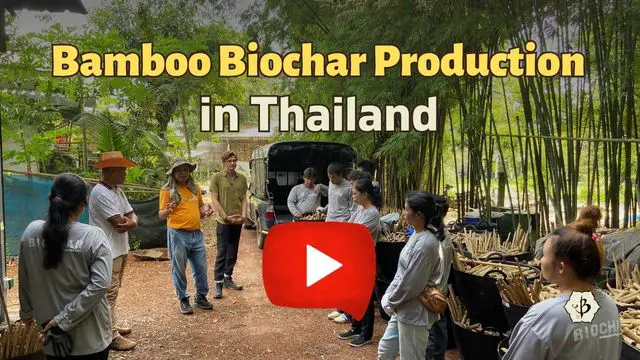
At first glance, biochar offers little in the way of beauty or elegance. But beneath the surface, in those carbon-rich nooks and crannies, there’s something magical taking place. Biochar, like its close cousin, charcoal, is produced through pyrolysis – a process of thermochemical transformation, in an oxygen-deprived environment, at temperatures of around 400-700º C. It may not be sexy, but it gets the job done. And unlike charcoal, which is commonly used (especially in the Global South) for cooking and heating, and releases plumes of CO₂ and other greenhouse gases, biochar serves a completely different purpose.
The real beauty of biochar lies in its circularity. It begins with something as humble as a heap of waste. Any agricultural residues will do, but bamboo scraps and offcuts provide some of the best feedstock. If that organic waste were left alone, it would naturally decompose, and all the CO₂ that was collected during its lifetime of photosynthesizing would be released straight back into the atmosphere. That’s the carbon cycle, in essence.
Interrupting this cycle, pyrolysis locks that carbon in a stable form, preventing it from returning into the atmosphere. High-quality biochar from woody biomass usually has a carbon content of about 70 to 80 percent. When used as a soil additive, which is the preferred application for biochar, the carbon is captured in the ground, where the vast majority will remain for hundreds if not thousands of years.
This carbon sink is not only an effective tool in the battle against climate change, keeping the carbon from oxidizing and returning to the sky in the form of CO₂, but it also brings tangible benefits to the soil. Carbon in the atmosphere is a problem, one of the leading causes of climate change, as you’ve probably heard. But low carbon content in the ground is another serious threat, impacting soil fertility and crop yields.
Biochar is not a fertilizer, but it is an extraordinary soil conditioner, and increasing the soil organic carbon is only the beginning. It’s the porosity of biochar, its sponge-like composition, that makes it truly remarkable for enhancing water and nutrient retention. The honeycomb-like structure of cavities and nanopockets creates an inviting environment where lonely microbes can come together and do what microbes have been doing since the dawn of time.
Ultimately, this leads to healthier and faster-growing plants, which will capture more carbon and produce higher yields, at the same time requiring less irrigation and fertilization, two activities with significant carbon footprints of their own. Between bamboo’s famously vigorous growth habit and biochar’s ability to turn discarded biomass into sustenance, the benefits are visible at every step of the cycle.

The most successful bamboo biochar models I’ve seen utilize the premium poles for higher-value products, such as furniture or building materials. This processing results in considerable volumes of offcuts, but there’s no need for those to go to waste. Biochar production is relatively straightforward, and it makes excellent use of that leftover biomass. And since biochar in the soil represents a long-lasting carbon sink, it’s also possible to monetize the operation with high-value Carbon Credits. But that’s a heartwarming story for another time.
Like bamboo, biochar has a hundred lessons to teach us, about circularity, about giving and receiving, and about embracing all the aspects of yin and yang. And like all things circular, my love for bamboo will surely never end.
This article was originally written for AsIB, the Iberian Bamboo Association, such a loving and eclectic band of bambuseros.